
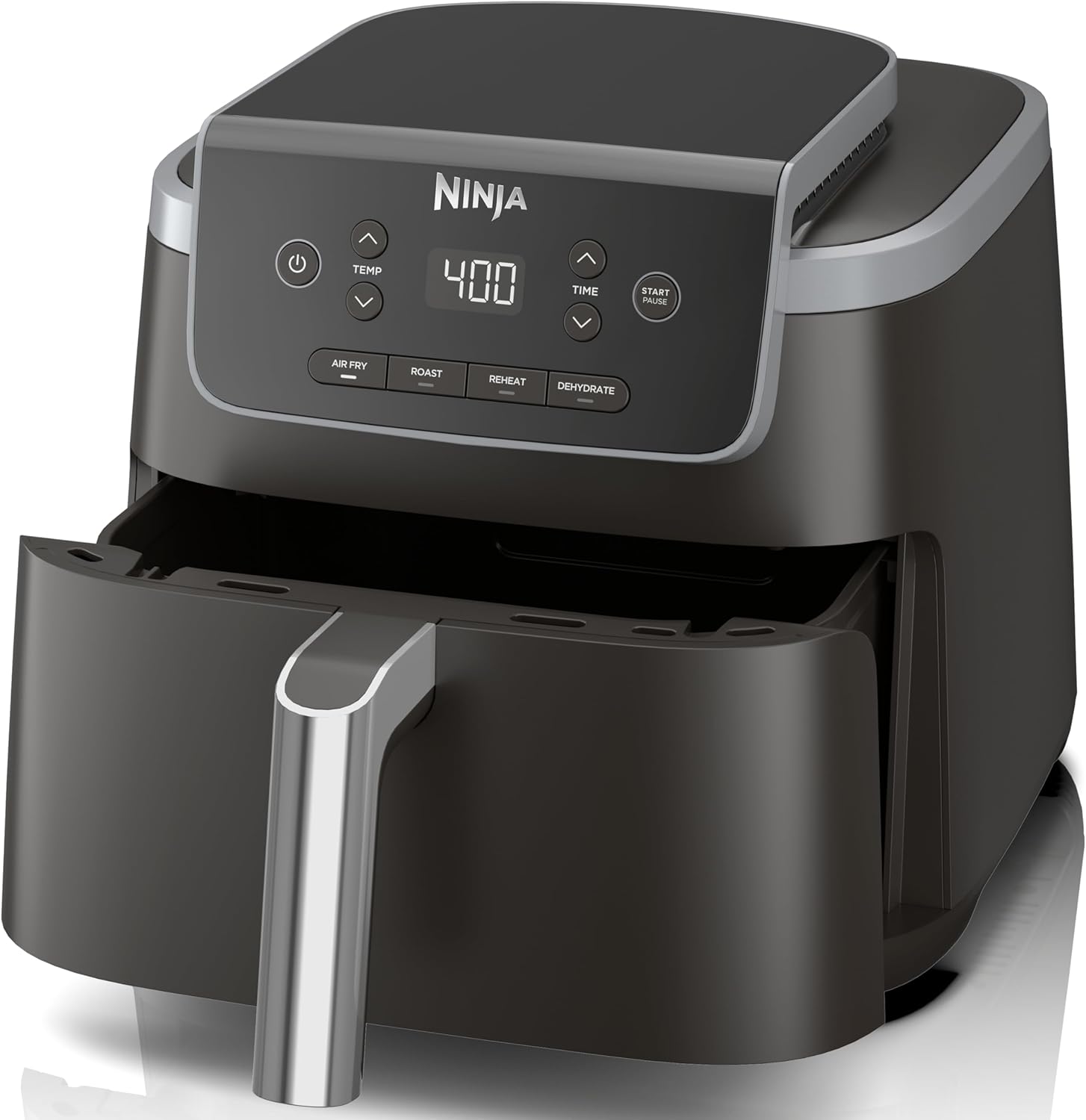
The Ninja AF141 is a compact countertop air fryer designed to handle several everyday cooking tasks in one appliance: air frying, roasting, reheating, and dehydrating. It targets the “weeknight convenience” use case—quick cooking with a crisp finish—while keeping the footprint and capacity appropriate for small households or side dishes for larger meals.
This article explains what the 4 functions mean in real cooking terms, how the 5-quart size typically fits into a kitchen routine, and what to expect from a 400°F maximum temperature and a nonstick basket/crisper plate setup.
Core specifications (from the product name)
These are the only details assumed in this article:
- Brand/model: Ninja AF141
- Functions: 4-in-1 (Air Fry, Roast, Reheat, Dehydrate)
- Capacity: 5QT (states it fits up to 4 lb of French fries)
- Max temperature: 400°F
- Parts: Nonstick basket and crisper plate
- Power: 120V
- Color: Grey
What “4-in-1” means for everyday cooking
1) Air Fry
“Air fry” is essentially high-velocity hot air circulation designed to brown and crisp the exterior of food. In practice, it’s most useful for:
- Frozen convenience foods (fries, nuggets, breaded items).
- Small proteins (wings, drumsticks, salmon portions, pork chops).
- Vegetable sides that benefit from browning (Brussels sprouts, broccoli florets, cauliflower, green beans).
A key advantage is texture: air frying can produce a crisp surface without deep-frying. Results still depend on the food’s own fat content (or a light coating of oil), spacing in the basket, and shaking/turning during cooking.
2) Roast
“Roast” usually emphasizes steady heat for more even cooking and browning, closer to a small convection oven. It tends to be used for:
- Thicker cuts or larger portions where the inside needs time to cook (chicken thighs, sausages).
- Sheet-pan-style meals adapted to a basket format (chopped veg + protein).
- Quick “oven-like” finishing (melting, browning, surface caramelization).
If air fry is about aggressive crisping, roast is often about balanced cooking: you still get browning, but with a little more gentleness and predictability for thicker foods.
3) Reheat
Reheat is meant to warm leftovers while restoring some surface texture. It’s commonly used for:
- Pizza slices (to re-crisp the bottom/edges).
- Fried foods and breaded items (to avoid sogginess from microwaving).
- Roasted vegetables and proteins (to warm without overcooking as quickly).
Tip for reheating: smaller batches and short timing help prevent the outside from drying out before the inside warms through.
4) Dehydrate
Dehydrate runs at lower heat for longer periods to remove moisture. It’s suited to:
- Fruit chips (apple, banana, mango—thinly sliced).
- Vegetable chips (kale, zucchini—thin and evenly cut).
- Jerky-style projects (depending on recipe and food-safety approach).
- Drying herbs (when handled cleanly and spread in a single layer).
Dehydrating is slow cooking by design. The “win” is shelf-stable snacks and ingredient prep, but it requires planning and consistent slicing thickness for even results.
Capacity: what 5QT can realistically do
A 5-quart air fryer is a middle-of-the-road size for many kitchens: large enough for a small family side dish, but still compact compared to larger dual-basket units. The product name suggests it can fit “up to 4 lb of French fries,” which is a capacity statement rather than a guarantee of best crispness in one batch.
In real use, basket air fryers perform best when food is not packed tightly:
- For maximum crisping, cook in a single layer when possible.
- If you need to load more food, plan to shake the basket more often and accept that the crispness may be slightly less uniform.
- For foods that release moisture (fresh potatoes, vegetables), crowding can lead to steaming instead of browning.
Temperature up to 400°F: why it matters
A 400°F maximum temperature is typical for many air fryers. Higher heat is useful for:
- Rapid browning on breaded items and fries.
- Crisping chicken skin.
- Finishing foods that are already cooked but need texture (reheating).
Lower temperatures (used in roast or dehydrate modes) are useful for:
- Preventing delicate foods from over-browning before the center cooks.
- Avoiding sugar burn on sweet glazes or marinades.
- Slow moisture removal for dehydration.
In practice, temperature is only one part of crispness; airflow, spacing, and surface dryness matter just as much.
Basket + crisper plate: what they do
This product is described as having a nonstick basket and a crisper plate.
- The basket is the main cooking chamber, holding the food and allowing hot air circulation.
- The crisper plate typically elevates food slightly, encouraging airflow under the food so the bottom can brown better and drippings can fall away.
Nonstick surfaces can make cleanup easier, especially for sticky marinades or breaded foods. To keep nonstick surfaces performing well over time, many users avoid metal utensils and abrasive scrubbers, and let hot parts cool before washing.
Cooking patterns this model is well-suited for
Because it’s a 5QT basket-style unit with 4 core functions, the Ninja AF141 fits a few common routines particularly well:
- Quick frozen-food prep (fries, nuggets, mozzarella sticks) with better texture than a microwave.
- Small-batch proteins (chicken pieces, fish portions, sausages).
- Weeknight vegetables with browning (broccoli, carrots, cauliflower).
- Leftover revival (pizza, roasted potatoes, fried chicken).
- DIY snack prep via dehydration (fruit chips, dried herbs).
This kind of appliance is often used as a “secondary cooker” alongside a stovetop—handling crisping and roasting while the stove handles pasta, rice, or sauces.
Food ideas by function (no hype, just practical matches)
Air Fry
- Frozen French fries (shake mid-cook for even browning).
- Chicken wings (space them out; flip or shake).
- Breaded fish fillets (avoid overcrowding).
- Crispy chickpeas (dry well first; season after or midway).
Roast
- Chicken thighs or drumsticks (check internal doneness per safe cooking guidance).
- Roasted sweet potato cubes (oil lightly; don’t crowd).
- Sausages with peppers/onions (stir once or twice).
- Salmon portions with vegetables (use parchment designed for air fryers if desired, but keep airflow in mind).
Reheat
- Pizza (short bursts; avoid over-drying).
- Leftover fries (single layer improves texture).
- Fried items (watch closely—they re-crisp fast).
- Roasted vegetables (toss halfway if needed).
Dehydrate
- Apple slices with cinnamon.
- Citrus wheels for garnish (thin slices, longer time).
- Herb drying (clean, dry herbs laid in a single layer).
Practical use tips that typically improve results
These are general basket-air-fryer habits that usually help:
- Preheat if your recipe expects it (especially for crisp frozen foods).
- Pat foods dry (moisture reduces browning).
- Use small amounts of oil when needed (a light coating can improve color and texture).
- Shake or flip mid-cook for even results.
- Avoid overcrowding for crispness; cook in batches when necessary.
Care and handling basics
Since this unit is described as having nonstick cooking parts:
- Let the basket/crisper plate cool before washing.
- Use non-abrasive sponges and non-metal utensils.
- Remove excess grease or stuck-on sugars sooner rather than later (heated sugar-based sauces can harden).
(If you want, share whether you plan dishwasher cleaning or hand-wash only, and the article can be tailored to that preference without guessing.)
Who this model tends to suit
Based on the functions and capacity in the product name, it’s a practical fit for:
- People who want crisp textures without running a full-size oven.
- Small households needing weeknight speed and simple cleanup.
- Meal-preppers who like quick protein + veg batches.
- Snack-makers interested in dehydration (fruit chips, dried garnishes).
It may be less ideal if you regularly cook for large groups in one batch, since basket units generally crisp best with some space between pieces.
Optional add-ons (compatibility depends on the exact basket shape)
Without assuming any included accessories, common optional add-ons people use with basket air fryers include:
- Heat-safe silicone tongs (for turning food).
- Oil mister/sprayer (for light, even coating).
- Small air-fryer-safe liners or parchment (used carefully to avoid blocking airflow).